
Accessibility: turning obligation into opportunity
Dorien Deckers, Ipsos Belgium
Senior Research Curator

The recent European Accessibility Act might be seen as a compliance hurdle, but it is an opportunity for brands to create deeper consumer trust, build a more inclusive future, and even drive innovation. This article delves into public perceptions of (in-)equality and accessibility, and the role brands can play to benefit people ánd business. Read on to learn how embracing accessibility and inclusivity transcend legislative compliance and can build new brand opportunities.
Understanding the ‘World’s Biggest Minority’
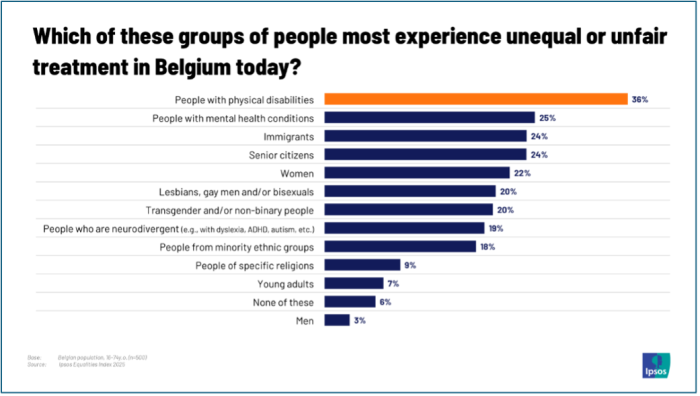
The Ipsos Equalities Index is a 31-country survey that shines light on public perceptions on the issue of social inequality. It reveals that -in the eyes of the Belgian population- people with physical disabilities face the greatest inequality in society today, with 36% of Belgian adults marking it as the group that most experiences unequal or unfair treatment in Belgium.
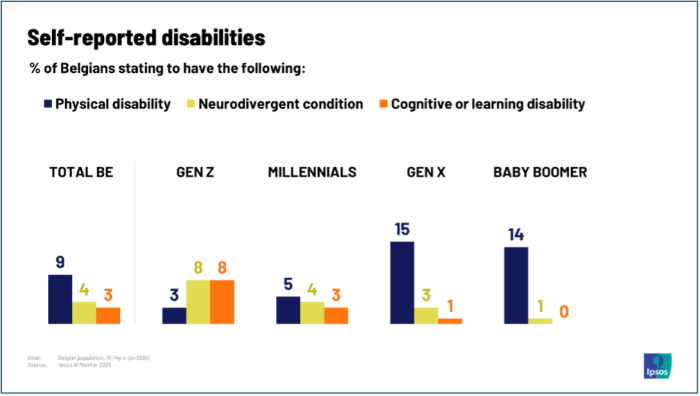
While vulnerable to receiving unequal treatment, these groups are not a small minority. In the Ipsos Equalities Index, 9% of Belgians between 16-74y.o. stated to have a physical disability. The number goes up with age, to 15% among 50-74y.o. On a global scale, it is expected that the proportion of people with disabilities will only go up in the future, with ageing populations, growing chronic conditions and mental illness. The UN coins it ‘the world’s biggest minority’.
Media and brands increasingly held responsible to create accessible experiences
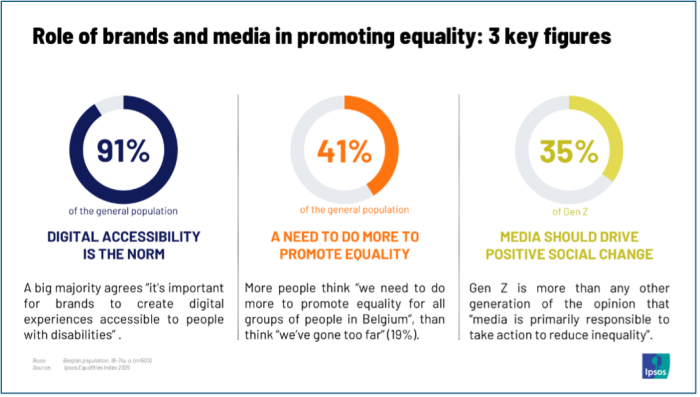
Promoting equality is a sensitive, hot topic that is currently receiving resistance. Still, more people say that attempts to promote equality for all groups of people should go further, than those who say they’ve gone too far already. In Belgium, 41% says we need to go further (vs. 19% saying it has gone too far) – on par with the average of the EU countries in the Ipsos survey. While the government is seen as having the primary responsibility for promoting equality, brands and media are not off the hook. Strikingly, Gen Z places significant more responsibility on the media (35%) to drive social change than older generations do, signaling a trend of increasing expectations for brands to step up.
The European Accessibility Act, effective June 28, 2025, requires businesses in the E.U. to make their digital products and services accessible. Non-compliance can lead to legal complaints and fines. But the law is only the beginning of the story. The real motivation for brands should be the overwhelming expectation and need coming from consumers themselves. An astounding 91% of Belgians believe it's important for brands to create digital experiences that are accessible to people with disabilities — a sentiment shared across all ages and genders. This sentiment is also shared by 88% of people across all 31 countries in the survey.
Finding business opportunities beyond the mainstream
Don’t let legal compliance to new regulation be your sole motivation to invest in enhanced accessibility. Accessibility is relevant for anyone. In fact, a lot of innovations have come from the world of accessible UX. Audiobooks, voice recognition technology, and even the electric toothbrush originated as solutions for specific needs but evolved into products that offer convenience and an enhanced experience for everyone. Innovation originally inspired by a niche segment, can create new segments in all industries.
So, how can your brand turn the accessibility mandate into a strategic advantage?
- See the world through THEIR eyes with deep listening: to uncover real opportunities, you must first understand the challenges and tensions of your audience. This requires "deep listening" — observing without judgment, letting go of your own biases, and letting the consumer lead the conversation. Brands often miss opportunities due to unintended biases and assumptions that create blind spots. Genuinely connecting with niche consumers requires a deep, empathetic understanding of their needs and behaviors.
- Prioritize purposeful partnering: a shift in focus towards previously overlooked audiences opens the door for "purposeful partnering", creating a mutually beneficial relationship for both the community and the business. Looking for win-win solutions is essential to render an authentic and credible brand. An empathetic and strategic focus on a "niche"-target can transform inclusivity and accessibility initiatives from a cost center into a value driver, ensuring authenticity, brand coherence, and long-term impact.
- Implement UX research: transforming your digital platforms requires a thorough approach. To make this process efficient, we recommend a modular UX research process: first, an automated WCAG (Web Content Accessibility Guidelines) checker can quickly discover up to 60% of accessibility issues. Next, a manual expert review can identify an additional 15% of nuanced problems that automated tools miss. Finally, qualitative UX user flow testing with real users uncovers another 15% of issues, ensuring the experience is not just technically compliant but genuinely seamless and user-friendly.
In short: the European Accessibility Act is more than a new law; it can be a catalyst for social change ánd business growth. For brands ready to look beyond the obligation, it is a clear pathway to innovation, deeper customer connection, and becoming a trusted brand.
This article is based on a survey by Ipsos in 31 markets with 23,228 respondents aged 16-74, including 500 Belgians. Fieldwork took place between February 21 and March 7, 2025. Quotas were established to ensure representativeness, and data was weighted to the known population profile of each country.
The full report can be found here.
Also interesting for you
-
New anti-greenwashing rules: is your sustainability communication ready for 27 September?
From 27 September 2026, the European Empowering Consumers for the Green Transition (ECGT) Di...UBA Focus News
-
Les Binet on the cost of small thinking
At UBA Media Date 2026, Professor Les Binet delivered a blunt warning: the industry’s ...UBA Focus News
-
AI in advertising: new guidelines for transparency and responsible use
To help the Belgian advertising ecosystem use AI responsibly, the Advertising Council and it...UBA Focus News