
Data governance as a growth lever

Grégory Marchandise, UBA
Domain lead Data & Technology and Content
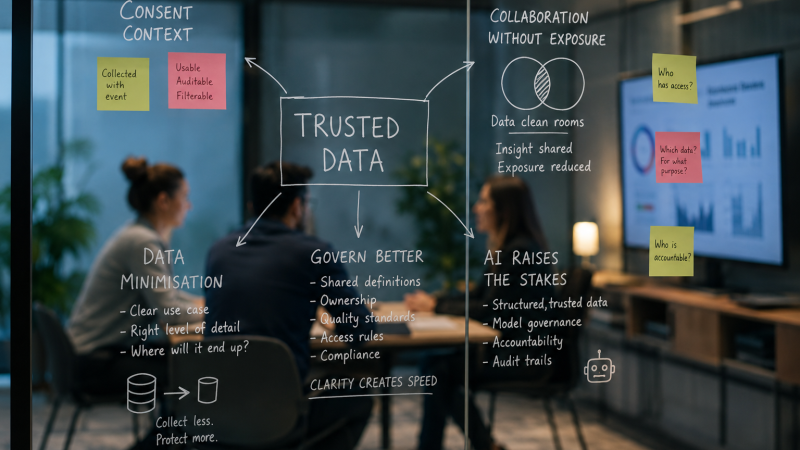
At the UBA Exchange Community Data & Tech session, experts showed why marketing performance increasingly depends on trusted, well-governed data. The key message: brands do not win by collecting more data, but by using it more responsibly.
Trusted data is now a marketing advantage
During the latest UBA Exchange Community Data & Tech session, Glenn Vanderlinden from Human37, Ruben Tip from Snowflake and Sophie Angenot from QuaData explored one shared challenge: how can brands collaborate, personalise and innovate with data without losing control?
The answer starts with a shift in mindset. Data is no longer just a technical asset. It is the raw material behind market research, CRM, media, personalisation, analytics and AI. But more data does not automatically mean better decisions. When teams use different definitions, when ownership is unclear or when consent is not carried through the ecosystem, marketing decisions slow down or become unreliable.
Consent cannot stay at the entry point
Modern marketing stacks are highly connected. A CDP connects to a warehouse, the warehouse connects to activation tools, and those tools connect to advertising, CRM, email and analytics platforms. That connectivity creates speed, but also risk.
Glenn Vanderlinden highlighted a simple but critical issue: consent is often captured once, at the entry point, while data continues to move downstream. The stack moves the data brilliantly, but not always the reason why that data was collected. That makes it difficult to know whether a data point can still be used for analytics, marketing or personalisation.
A practical response is consent context: storing the user’s consent state with the event itself. Consent then becomes a usable data attribute that can be filtered, joined and audited, instead of being locked in a separate compliance system.
Govern less data, but govern it better
Data minimisation was another recurring theme. The cheapest data to protect is the data you never collect. Before capturing or activating data, marketers should ask: do we have a clear use case, do we need this level of detail, and where will the data end up?
Sophie Angenot connected this to the broader role of data and AI governance. Governance is not about slowing teams down with bureaucracy. Done well, it creates clarity and speed. Shared definitions, clear ownership, quality standards, access rules and compliance policies help teams trust the numbers they use every day.
For marketers, this means starting where the pain is most visible: customer identity, consent, campaign KPIs, NPS definitions or attribution. Governance becomes manageable when it is embedded in business teams and treated as a living practice, not a one-off policy document.
Collaboration without exposure
Ruben Tip showed how governance can enable collaboration instead of blocking it. With the right access control, data minimisation and audit logs, organisations can work with partners while keeping control over what is shared, who sees it and how it is used.
Data clean rooms illustrate this shift. They allow two parties to analyse combined data without exposing raw customer records. A brand and a media partner can, for example, measure campaign impact without exchanging customer lists. A retailer and a brand can explore audience enrichment without revealing personal data. The insight is shared, but the exposure is reduced.
This is where governance becomes a competitive edge. It makes data collaboration safer, more scalable and more useful for marketing teams.
AI raises the stakes
The session also made clear that AI does not reduce the need for governance. It increases it. AI depends on structured, labelled and trustworthy data. It also brings new questions: which tools are being used, on what data, under which rules, and who is accountable for the output?
AI governance builds on data governance, but goes further. It covers model selection, model versioning, agent behaviour, unstructured data and audit trails. When an AI agent sends emails, updates records or triggers campaigns, marketers are no longer only governing data. They are governing actions.
A good starting point is to bring marketing, legal and data teams into the same room and ask three questions: do we know where our key data comes from, do we trust it, and do we know who is accountable when something is wrong?
Also interesting for you
-
New anti-greenwashing rules: is your sustainability communication ready for 27 September?
From 27 September 2026, the European Empowering Consumers for the Green Transition (ECGT) Di...UBA Focus News
-
Les Binet on the cost of small thinking
At UBA Media Date 2026, Professor Les Binet delivered a blunt warning: the industry’s ...UBA Focus News
-
AI in advertising: new guidelines for transparency and responsible use
To help the Belgian advertising ecosystem use AI responsibly, the Advertising Council and it...UBA Focus News